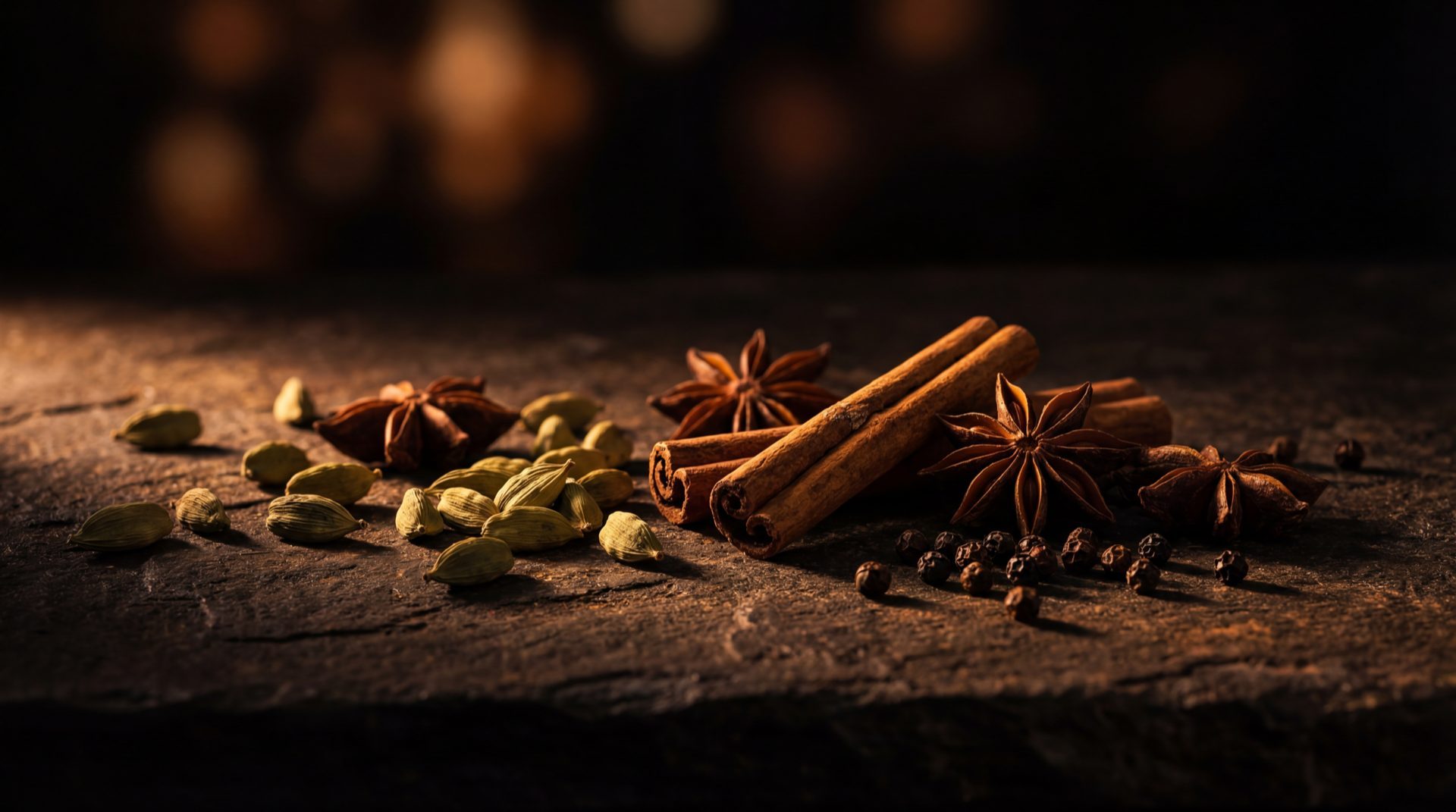
SPICEAXIOM
The fundamental
truth of flavor.
Chai has never been given the precision it deserves.
We’re fixing that.
SPICEAXIOM
Chai has never been given the precision it deserves.
We’re fixing that.
Tunable by Design
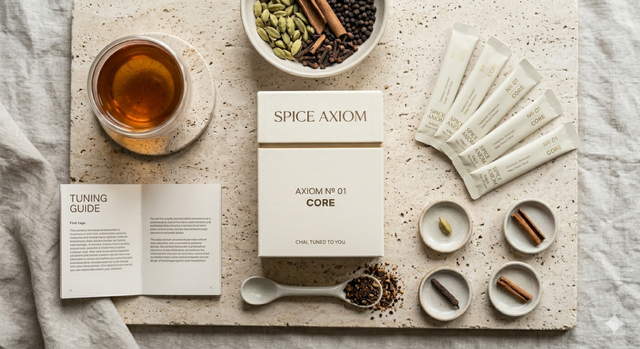
AXIOM Nº 01 — CORE is not a ready-made drink. It is a precision spice system. The blend is fixed and perfected. Everything else — the intensity, the sweetness, the richness — is yours to set. This is the point. A cup that is exactly right for you cannot be pre-made by someone who has never met you.
01
How much spice the moment calls for.
Each serving comes in its own tube. Use a partial measure and the cup is subtle — warm, aromatic, present in the background. A quiet start to the morning. Pour the full tube and the spices assert themselves fully: cardamom forward, ginger bright, the dual-pepper finish long and deliberate. Bold. Unapologetic.
02
The variable that changes everything about the cup.
Unsweetened, AXIOM Nº 01 is a study in pure spice — nothing softened, nothing hidden. The cardamom is sharp and floral. The pepper is direct. Add a sugar tube and something remarkable happens: the cardamom’s floral character opens fully, the pepper’s heat resolves into warmth, and the cinnamon moves into a register that feels ancient and unhurried. More sweetness still, and the cup becomes deeply comforting. Each level is a different cup.
Our precision sugar tubes use unrefined cane sugar. Honey, jaggery, or any sweetener of your own works equally well.
03
From bright and clean to deeply lush.
Made with hot water alone, AXIOM Nº 01 is bright and clear — a pure spice tea, nothing between you and the blend. Add a powdered cream tube and the character shifts completely. Ginger softens. Cardamom moves from electric to lush. Cinnamon warmth opens and spreads. The whole cup becomes rounder, fuller, more enveloping. A second tube of powdered cream and you are somewhere else entirely — close to a traditional masala chai, the spices still present but held now in something warm and deep.
Our powdered cream tubes use whole milk powder. Fresh milk, oat, almond — any liquid milk works directly in place of or alongside the cream tubes.
Specialty coffee has its single origins.
Matcha has its ceremonial grades.
Whiskey has its distillery provenance.
Chai has had none of that.
Until now.
![[900×1100px | 72dpi | JPG] AXIOM Nº 01 — CORE single-serve tube on dark surface, dramatic side lighting](images/product-pouch.jpg)
Flagship Product
A precision chai spice system.
Every cup of AXIOM Nº 01 begins with the same obsessive foundation: a fixed blend of sourced spices and premium tea, ratioed to the gram. What happens next is entirely yours. The intensity. The sweetness. The richness. We design the constant. You define the expression.
“We design the first 80%.
You define the last 20%.”
The Experience
![[1920×800px | 72dpi | JPG] Professional food photography: hands cupping a steaming chai in a ceramic bowl, warm amber steam rising, dark moody background, intimate editorial style, shallow depth of field](images/taste-cup.jpg)
Cardamom announces itself first — bright, floral, slightly electric, with the clean eucalyptus-like clarity of freshly cracked pods. It does not wait. Beneath it, Vietnamese cinnamon rises slowly: not sweet exactly, but warm and resinous, with a depth that genuine mountain-grown bark carries and most cinnamon never achieves. Together they set an expectation. The cup delivers on it.
Cardamom leads the palate as it led the nose — the dominant voice in the blend, aromatic and alive. Organic ginger follows immediately: sharp, clean, and bright, it lifts the entire cup and keeps it from settling into heaviness. Vietnamese cinnamon builds warmth through the middle. This is not a background note. These three spices together are the forward momentum of AXIOM Nº 01 — the reason the first sip asks for a second.
This is where the complexity lives. Organic clove steps in with dark structural depth — a single note that anchors everything above it without dominating. Mace, the rare lacy aril of the nutmeg fruit, adds a quality most people will feel before they can name: a warm, slightly floral complexity that is neither nutmeg nor pepper but something more elusive. Star anise and fennel move quietly through the middle, lending a soft anise sweetness that rounds the edges of the sharper spices. Jamaican allspice deepens everything — named for the way its aroma seems to carry cinnamon, clove, and nutmeg simultaneously — adding a quiet density the blend would miss immediately if removed.
Long. Intentionally long. Malabar black pepper fires first — sharp, immediate, and clean. Long pepper follows with something more layered: a slower, more resinous heat, faintly sweet with a woody depth that builds well past the cup and stays. Together, the dual-pepper system creates a finish more complex than either alone. Coriander threads a faint citrus-earthy note through the close. The premium tea — present as backbone throughout — adds tannin structure that holds all of this in place and makes the finish feel complete rather than simply ending.
Cream transforms the cup. The sharp brightness of ginger softens. Cardamom moves from electric to lush. Vietnamese cinnamon warmth opens fully. The pepper heat integrates rather than leads. The cup becomes rounder, fuller, more enveloping — something that sits in the chest with warmth. Full-fat dairy, oat, or a cream tube work differently but well. Each shifts the character slightly. Adjust until it is exactly right. That is the point.
A touch of sweetener — honey, jaggery, raw cane sugar — does something remarkable: it releases the floral dimension of cardamom fully, softens the pepper into warmth rather than heat, and brings the cinnamon into a register that feels ancient and unhurried. The cup becomes something that tastes like it was made somewhere specific, for someone specific, with full attention. That is the intention.
Sourced With Intent
We do not use the nearest version of an ingredient. We use the right one. Each spice in AXIOM Nº 01 was selected not just for flavor but for origin — because where something grows, and how, changes what it tastes like. Here is what we chose, and why.
![[1920×960px | 72dpi | JPG] Professional food photography overhead flat-lay of whole spices arranged on aged dark slate: cardamom pods, cinnamon sticks, star anise, peppercorns, cloves, mace, ginger root. Dramatic natural light from above. Editorial style.](images/spice-flatlay.jpg)
![[400×400px | 72dpi | JPG] Macro food photography: bright green cardamom pods split open revealing rows of small dark aromatic seeds, arranged on aged dark slate, dramatic side lighting from the left, warm amber highlights, ultra-sharp macro detail, editorial style, no text](images/spice-cardamom.jpg)
Guatemala Highlands & Kerala, India
The soul of the blend. The dominant ingredient by volume and the identity of the cup.
True cardamom — Elettaria cardamomum — is called the Queen of Spices for good reason. The finest comes from the misty highland slopes of Guatemala, introduced there in the early 20th century by a German planter who found the altitude and moisture nearly identical to the spice’s ancestral home in the Western Ghats of Kerala. Today both regions produce exceptional cardamom, and the best of both share the same character: intensely floral, bright with citrus, carrying a clean eucalyptus-like clarity that most imitations never approach.
We use organic cardamom because the spice’s volatile oils — the compounds responsible for its aroma — are sensitive. Organic cultivation tends to produce pods and ground cardamom with higher aromatic intensity. In a blend where cardamom is the dominant note, that intensity matters.
Why not supermarket cardamom? Most pre-ground cardamom has already lost the volatile oils that make it remarkable. We source for freshness and intensity, not shelf life.
![[400×400px | 72dpi | JPG] Macro food photography: Vietnamese cinnamon bark pieces showing rich reddish-brown color and visible wood grain texture, some rolled into quills, arranged on dark slate, warm dramatic lighting revealing texture and depth, editorial style, no text](images/spice-cinnamon.jpg)
Thanh Hoa & Yen Bai Provinces, Vietnam
The warmth of the blend. More resinous and intense than any other cinnamon variety on earth.
There are four major cinnamon varieties used in food and drink: Ceylon (Sri Lanka), Cassia (China), Korintje (Indonesia), and Vietnamese, also called Saigon cinnamon. They are not interchangeable. Vietnamese cinnamon — Cinnamomum loureiroi — contains a cinnamaldehyde concentration of 4–6%, compared to Ceylon’s 0.5–1%. That is not a subtle difference. It is the difference between a flavor that whispers and one that speaks.
Grown in the mountainous provinces of northern Vietnam at elevations that slow bark development and concentrate essential oils, Vietnamese cinnamon has a warm, almost sweet intensity — resinous, full, and complex in a way that Chinese cassia (the most common commercial variety) does not achieve.
Why not Mexican cinnamon (Ceylon)? Ceylon, while excellent in delicate applications, is too light to hold its own against cardamom, pepper, and clove. We want cinnamon you can taste. Vietnamese cinnamon delivers that.
![[400×400px | 72dpi | JPG] Macro food photography: dried mace blades showing intricate lacy filigree texture in deep orange and amber tones, arranged on dark matte slate, dramatic raking side light highlighting the delicate lattice structure, editorial macro style, no text](images/spice-mace.jpg)
Banda Islands, Maluku, Indonesia
The complexity. A note most people feel before they can identify.
Mace is the lacy red aril that encloses the nutmeg seed on the Myristica fragrans tree. Both come from the same fruit. Nutmeg is the seed — warm, slightly sweet, familiar. Mace is the covering — more delicate, more floral, with a peppery warmth distinct from both the nutmeg it surrounds and the pepper it resembles.
The finest mace comes from the Banda Islands, the original Spice Islands of the Maluku archipelago — the remote chain of volcanic outposts in eastern Indonesia that European powers fought wars over for centuries. The volcanic soil and equatorial climate produce a spice that is used far less than it deserves to be. Outside professional kitchens, mace is nearly unknown. We consider this an opportunity.
Its presence in AXIOM Nº 01 produces the quality tasters describe but cannot quite name — a warm, floral depth that sits beneath the more assertive spices and makes the blend feel more considered than it would without it.
![[400×400px | 72dpi | JPG] Macro food photography: organic ginger root with rough golden-tan skin showing fibrous texture, one piece sliced to reveal pale yellow fibrous interior, arranged on dark slate, warm side lighting, editorial macro style, no text](images/spice-ginger.jpg)
Cochin, Kerala, India
The brightness. Sharp, clean, and present from the first sip.
Cochin ginger — named for the port city through which much of Kerala’s spice trade flows — is among the most prized ginger varieties in the world. It carries a higher concentration of volatile oils than most commercial ginger, producing a flavor that is genuinely sharp and bright rather than merely hot. It lifts. It clarifies. In a blend that runs toward depth and warmth, organic Cochin ginger is the counterweight that keeps the cup alive.
We use organic ginger because the gingerols and shogaols responsible for ginger’s distinctive flavor and heat are significantly more concentrated in organically grown root, where slower growth and richer soil produce a spice with more character per gram.
![[400×400px | 72dpi | JPG] Macro food photography: Malabar black peppercorns close-up, some whole showing wrinkled dark surface, some cracked open revealing lighter interior, arranged on dark slate, dramatic raking side light, ultra-sharp macro detail, editorial style, no text](images/spice-black-pepper.jpg)
Malabar Coast, Kerala, India
The immediate heat. Sharp, precise, and structural.
Black pepper has been called the King of Spices. For most of human history, it was literally worth its weight — Attila the Hun demanded it as ransom for Rome. Malabar pepper, grown along the southwest coast of India where the Western Ghats meet the sea, is among the oldest cultivated pepper in the world. Its flavor is clean, direct, and pungent — the foundational heat note that signals to the palate that something serious is happening.
In AXIOM Nº 01, black pepper fires first in the finish. Immediate, clean, and precise. It establishes the heat platform on which long pepper then builds its slower, more complex warmth.
![[400×400px | 72dpi | JPG] Macro food photography: long pepper (Piper longum) showing distinctive elongated catkin-like spike form, dark brown with visible seed clusters along the shaft, arranged on dark slate, dramatic lighting showing the unusual texture, editorial macro style, no text](images/spice-long-pepper.jpg)
Western India & Java, Indonesia
The extended finish. Slower, more resinous, and more complex than black pepper alone.
Long pepper — Piper longum — predates black pepper in European and Middle Eastern cooking by centuries. It was the pepper of ancient Rome, medieval Europe, and the earliest spice trade routes. When black pepper arrived from Malabar in quantity, long pepper was gradually displaced — not because it was inferior, but because black pepper was cheaper to produce at scale.
The two peppers are related but meaningfully different. Long pepper’s heat is slower and more layered — faintly sweet, with a woody, almost balsamic depth that black pepper does not carry. Where black pepper creates a sharp, immediate punctuation mark, long pepper creates a sentence that continues past the last word.
The dual-pepper system in AXIOM Nº 01 exists for this reason: two peppers that do different things with heat, together producing a finish that neither achieves alone.
![[400×400px | 72dpi | JPG] Macro food photography: whole organic cloves arranged on dark slate showing the distinctive nail-like shape with bulbous bud and long stem, deep mahogany brown color, dramatic side lighting highlighting form, ultra-sharp detail, editorial style, no text](images/spice-cloves.jpg)
Zanzibar, Tanzania & Maluku, Indonesia
The structural anchor. Dark, deep, and essential.
The dried flower bud of Syzygium aromaticum, cloves are one of the most concentrated flavor compounds in the spice world. A small amount provides enormous structural depth. The finest cloves come from Zanzibar — the Spice Island off the Tanzanian coast — and from the Banda Sea islands of Indonesia. They share an intensity of eugenol (the compound responsible for clove’s distinctive character) that lesser-origin cloves simply do not match.
In AXIOM Nº 01, organic clove functions as the anchor of the mid-palate — the dark note that prevents the brighter spices from becoming unmoored. Without it, the blend floats. With it, the blend holds.
![[400×400px | 72dpi | JPG] Macro food photography: perfect whole star anise pods arranged symmetrically on dark slate, showing the eight-pointed star form with seed chambers and woody texture, deep amber-brown color, dramatic overhead lighting, ultra-sharp detail, editorial style, no text](images/spice-star-anise.jpg)
Guangxi Province, China & Northern Vietnam
The rounding note. Among the world’s most expensive spices by weight.
The dried seed pod of Illicium verum, star anise bears no botanical relation to anise seed but shares its distinctive anethole compound — the molecule responsible for the soft, slightly sweet licorice character both carry. The finest comes from Guangxi Province in southern China and the adjacent provinces of northern Vietnam, where the subtropical climate and specific soils produce pods with high oil content and clean flavor.
In the blend, star anise works quietly. It does not lead. It smooths — rounding the edges of sharper spices, creating a slight natural sweetness in the mid-palate. Its price per kilogram reflects its labor-intensive harvest and brief seasonal window. We use it because the blend is different without it.
![[400×400px | 72dpi | JPG] Macro food photography: Lucknow fennel seeds close-up, pale sage green elongated seeds with faint ribbing and fine texture, arranged loosely on dark matte slate, soft dramatic lighting, editorial macro style, no text](images/spice-fennel.jpg)
Rajasthan, India
A gentle anise softness that rounds without announcing itself.
Lucknow fennel from Rajasthan — small-seeded, sweeter, and more delicate than Western varieties — has been used in South Asian spice blends for centuries. Where star anise provides a clean, assertive anethole note, fennel provides a gentler, warmer version of the same quality. Together they create a soft anise undercurrent in the blend that smooths transitions between the more assertive spices. Fennel is present in AXIOM Nº 01 not as a flavor to identify, but as a quality to feel.
![[400×400px | 72dpi | JPG] Macro food photography: Jamaican allspice berries on dark slate, dark brown spherical berries resembling peppercorns but larger, some whole and some cracked open, dramatic raking side light revealing texture and color depth, editorial macro style, no text](images/spice-allspice.jpg)
Jamaica
Layered background warmth. The spice that sounds like many and works like one.
Allspice — Pimenta dioica — is named for the way its aroma simultaneously suggests cinnamon, clove, and nutmeg. It contains none of them. The eugenol, methyl eugenol, and caryophyllene in Jamaican allspice produce this multi-layered quality naturally, which is why Jamaican allspice is considered categorically superior to varieties grown elsewhere: the specific climate and soil of the Blue Mountains and surrounding regions produces a concentration of these compounds that other growing regions do not replicate.
In AXIOM Nº 01, allspice functions as depth — the background presence that makes the blend feel more complete than its individual parts might suggest. Blind tasters consistently notice when it is removed, though they cannot say what is missing.
![[400×400px | 72dpi | JPG] Macro food photography: coriander seeds close-up, pale golden-tan round seeds with subtle ridged texture, some whole and some split revealing interior, arranged on dark slate, warm soft side lighting, editorial macro style, no text](images/spice-coriander.jpg)
Morocco & Southern India
A citrus-earthy thread at the edge of the finish.
Coriander seed — distinct in character from the herb — carries a lemony, faintly floral, and slightly earthy quality. Moroccan coriander is considered among the finest for its higher linalool content, which produces a more citrus-forward character. It does not assert itself in AXIOM Nº 01. It adds a note the palate reads as brightness and clarity in the close of each cup, particularly when sweetened, where it complements and extends the floral dimension of the cardamom.
![[400×400px | 72dpi | JPG] Macro food photography: whole nutmeg showing oval form with rough mottled surface, placed next to a cross-section slice revealing the intricate marbled interior pattern, dark slate background, warm dramatic side lighting, editorial macro style, no text](images/spice-nutmeg.jpg)
Banda Islands, Maluku, Indonesia
Warm, slightly sweet depth. The counterpart to mace in the nutmeg family.
Where mace is the aril, nutmeg is the seed inside the same fruit. The two are related but distinct: nutmeg is warmer, slightly sweeter, more familiar. Together with mace, they create the full expression of Myristica fragrans — a botanical contribution no other spice can replicate. Banda Island nutmeg, like Banda Island mace, is grown on the same volcanic soil that made the Spice Islands the most valuable real estate in the 17th-century world. That heritage is in the flavor.
![[400×400px | 72dpi | JPG] Macro food photography: premium loose leaf Assam black tea leaves close-up, large whole leaves and broken leaf in deep mahogany and dark brown, arranged on dark matte slate surface, dramatic raking side light showing leaf texture and vein detail, editorial macro style, no text](images/spice-tea.jpg)
Assam, Northeast India
The backbone. The largest ingredient by weight. It carries everything else.
The largest ingredient by weight in AXIOM Nº 01 is also its most foundational. We do not use commodity tea. The tea in this blend was chosen for one specific quality: its ability to carry spice without competing with it. Assam tea — grown in the Brahmaputra river valley at low elevations in extreme heat and humidity — produces a leaf with high theaflavin content, strong malt notes, and bold tannin structure. These qualities are exactly what a spice blend of this intensity requires.
A lighter tea would disappear beneath the cardamom and pepper. A more delicate tea would be overpowered by the clove and cinnamon. Assam holds. It provides the structural base — the tannin backbone — that gives the cup its depth and ensures the finish has something to close against.
We select for the growing season and estate, not simply the origin. The difference between a well-sourced Assam and a commodity Assam is not subtle. This is where the cup either holds together or it does not.
![[900×1100px | 72dpi | JPG] Professional editorial photography: a weathered spice market in warm golden light, sacks of whole spices in foreground, depth of field pulling focus to color and texture, warm documentary style, no text](images/sourcing.jpg)
Our Approach
Every ingredient in AXIOM Nº 01 has a specific geographic origin because geographic origin produces a specific flavor result. Vietnamese cinnamon is not a premium version of cinnamon. It is a meaningfully different flavor compound. Banda Island mace is not premium mace. It is grown in soil that produces a specific aromatic concentration. Jamaican allspice is not premium allspice. The climate of those particular islands produces a particular combination of volatile oils that other allspice does not share.
We chose each origin the same way: by asking what version of this ingredient tastes best in this blend, and then sourcing that version. Not the nearest. Not the cheapest. The right one.
Our Philosophy
Specialty coffee took two decades to earn its precision. Roast profiles. Single origins. Dialed-in extraction ratios. Grind size measured in microns. The craft consumer learned to care, and the industry rose to meet them.
Matcha did the same. Ceremonial grades. Sourcing provenance. The bowl, the whisk, the intentional preparation. A centuries-old practice reexamined through the lens of quality.
Chai — one of the world’s oldest and most complex spice systems — has been left behind. Pre-mixed. Pre-sweetened. Reduced to powder packets and café syrups designed for speed and consistency rather than flavor.
We disagree with that.
SpiceAxiom was built to give chai the same precision treatment. Not a convenience product. Not a wellness supplement. A spice system — sourced ingredient by ingredient, ratioed obsessively, measured to the gram, and designed for someone who understands what it means to take flavor seriously.
AXIOM Nº 01 — CORE is the foundation. The fixed element. The part we designed. The intensity, the sweetness, the richness — those belong to you. That is not a limitation. That is the point.
Everything else is fixed. That’s the axiom.
A X I O M Nº 0 1 — C O R E
AXIOM Nº 01 — CORE is the first expression in the SpiceAxiom system. Coming soon.
![[1920×800px | 72dpi | JPG] Professional editorial photography: a vast spice market or field scene, warm golden hour light, atmospheric with depth, documentary style, warm amber and brown tones, no text](images/manifesto-wide.jpg)